As testing for wells contaminated with PFAS chemicals moves forward on the West Plains, residents are expressing concerns about how long it might take to get their wells tested and whether or not it is safe to eat the food grown in their gardens or livestock raised on their land.
The frustration was particularly evident during a meeting hosted by the Department of Ecology last month at the Shriner’s Event Center to discuss work being required by the City of Spokane and Spokane County to address PFAS contamination from fire retardant foam used at the Spokane International Airport for decades.
Jeremy Schmidt, a site manager for the Department of Ecology, said all airports were required by the Federal government to have AFFF, a type of firefighting foam. “They were required to have it,” he said. “They were required to test it.”
Schmidt said most of the contamination was caused by training with and testing the firefighting foam, not using it to deal with airplane crashes. “It takes a cup of product to contaminate an aquifer,” he said. “It doesn’t take much. That’s the problem.”
Washington State couldn’t regulate PFAS, a family of chemicals known as forever chemicals because they don’t break down in the environment, until they were declared a hazardous substance in 2021. Fairchild Air Force Base publicly identified PFAS contamination on and off base in 2017 from the same AFFF foam. The Spokane International Airport did not disclose its contamination to the Department of Ecology until 2023, though initial testing at wells on airport property identified PFAS contamination in 2017.
Last summer the City of Spokane and Spokane County, which jointly own the airport, were added as responsible parties in the clean-up effort. In January, the city and county submitted a draft PFAS investigation plan spelling out where and how they would perform testing and, eventually, clean up.
In mid-February, Ecology told the city and the county they had two weeks to come up with a plan to provide clean drinking water to people affected by contamination that originated at the airport. That can be done via providing bottled water or installing home water filtration systems. That deadline has since been moved to March 13, Schmidt said.
The city and county are operating under an agreed order that spells out testing to be done to determine the spread of contamination, identify interim actions that should be taken, identify possible methods of removing the contamination and then do a feasibility study of different clean-up options.
“It’s a long process,” Schmidt said. “We’re years from that.”
Despite Ecology ordering the City and Council to provide emergency relief by providing residents with contaminated wells with clean water, it will take time for well testing to be done to identify who needs that relief, Schmidt said.
Several of the 100 people who packed into the Shriner’s Event Center didn’t like that answer. “We’re drinking it, we’re showering in it, we’re feeding it to our animals,” one woman said. “What the hell are we supposed to do?”
Others asked about getting their blood tested for PFAS levels. “There’s not much you can do if it’s in your system except to stop ingesting it,” Schmidt said.
One man noted that he raised cattle and that it was impractical to buy bottled water for them to drink. “What am I supposed to do?” he said.
Another man said he paid to have his well tested. “It’s so contaminated,” he said. “We can’t even grow flowers. They die. We don’t dare grow anything to eat.”
He said he researched home filtration systems after getting his test results. “They wanted $8,000 to install a filtration system,” he said. “I can’t afford that.”
Another woman said she was concerned about the time it will take to test everyone’s wells and then provide drinking water. She also said she can’t afford the $400 it would cost to test her well.
Schmidt said that timeline will be part of the plan submitted to Ecology later this month, but acknowledged the urgency of the issue. “We need to get people’s wells tested and get them to stop drinking the water today,” he said.
Someone asked what the airport had done with their PFAS contaminated AFFF foam. Schmidt said it was still sitting at the airport in trucks, available for emergency use only. Several gasps were heard and someone said “They’re still using it.”
Schmidt said a new type of firefighting foam, which does not include PFAS, was recently approved for use. “SIA has the new product,” he said. “They have not transitioned to it yet.”
Another woman referenced the issues the Spokane International Airport has had, including not disclosing their PFAS contamination when required and at one point refusing to sign an agreed order to move forward with the clean-up process.
“Clearly the airport has flipped you the bird before, what happens if they don’t cooperate?” she asked.
Schmidt said progress has been made since the City of Spokane and Spokane County were added as responsible parties along with the airport. “I’m confident that between the three responsible parties, we’ll get this done,” he said.
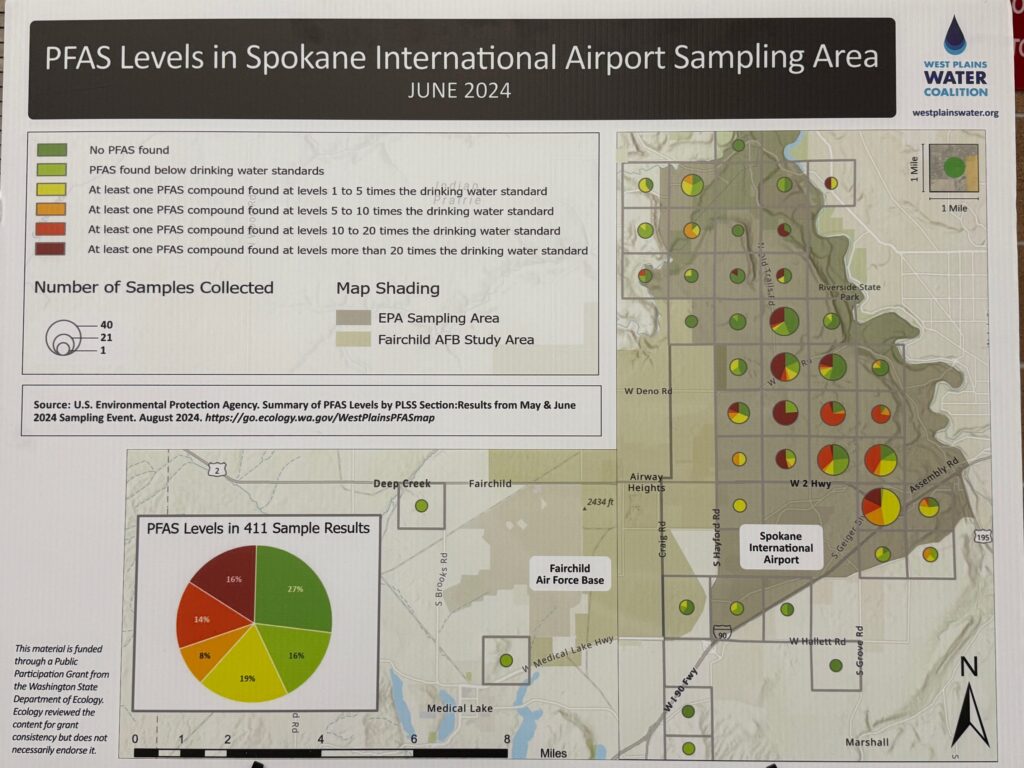
Testing at the airport has shown PFAS contamination in four primary areas: the current fire house, the historical firehouse, the fire training area and the stormwater recovery area on the northeast end of the airport property.
Schmidt said the geology of the West Plains is unique in that most of it is a thin layer of soil on top of basalt. The exception is old paleochannels, which are deep canyons carved by ancient floods. “Another flood came through and filled them with rocks and dirt,” Schmidt said.
Groundwater is able to move quickly through those paleochannels. Contaminated groundwater flows generally northeast from the airport. That area had some well testing done by the U.S. Environmental Protection Agency in 2024. The EPA tested 411 wells, 236 of which were contaminated above allowed levels. No contamination was found in 111 wells and very low levels were detected in 64 wells.
The problem with PFAS chemicals, in addition to them staying in the environment, is that studies are still underway to determine its effects on people, livestock and produce. The chemicals are thought to be tied to certain types of cancer, thyroid issues and low birth weight in babies.
If solid information is lacking on the effect of PFAS on people, there’s even less research on its impact on food. The Washington State Department of Health has been doing small amounts of testing on meat and eggs as their budget allows, said Department of Health Toxicologist Barbara Morrissey.
“We have been looking at home-raised livestock,” she said.
Their testing and research done at other contaminated locations around the country has shown that high levels of PFAS contamination does get into eggs and meat, Morrissey said. There is less data in regards to lower levels of contamination.
People have been asking about contamination in food since PFAS was first discovered on the West Plains, Morrissey said, and in the beginning the Department of Health had even less information than they do now. “At that point, the best we could advise was ‘It might be a problem,’” she said.
It costs $550 to analyze one sample and there was no budget for testing. DOH was previously able to get enough funding to test 30 samples and completed the first round of testing in December 2023 of meat and eggs from the West Plains and East Selah, another contaminated site. Some of those households had samples retested in November 2024 after homeowners made changes and more samples were tested in April 2025. A team just finished collecting additional samples to be analyzed.
“We were surprised at how much PFAS we found in the eggs,” she said. “We didn’t see as much in the meat.”

One of the slides by the Washington State Department of Health Toxicologist Barbara Morrissey at the West Plains Water Coalition Community meeting on March 9th at Medical Lake High School showing that 80% of households that provided eggs for testing came back with recommendation to limit consumption and 50% came back with significant limits on consumption.
Thirty households supplied 45 batches of chicken and duck eggs for testing. Nearly 80 percent of them had PFAS levels high enough that the Department of Health recommended either limiting the number eaten or not eating them at all. In the most contaminated batch, one egg had enough PFAS in it to equal the amount a person would consume by drinking contaminated water for 200 days, Morrissey said.
What has become clear is that switching to clean drinking water for chickens and other livestock does make a difference. One home that had high levels of contamination in their eggs started giving their chickens filtered water and also made changes to their chicken coop, moving it and reducing access to the dirt by putting down a thick layer of shavings. When the eggs were retested after the changes, the level of PFAS contamination had dropped sharply.
“We think there might be a soil pathway,” Morrissey said of the importance of moving a chicken coop. “We do think that is probably one of the factors.”
There are also many different types of PFAS chemicals and only certain ones were found in eggs, Morrissey said. “Not all of the PFAS in your well water are bioacummulative in eggs,” she said.
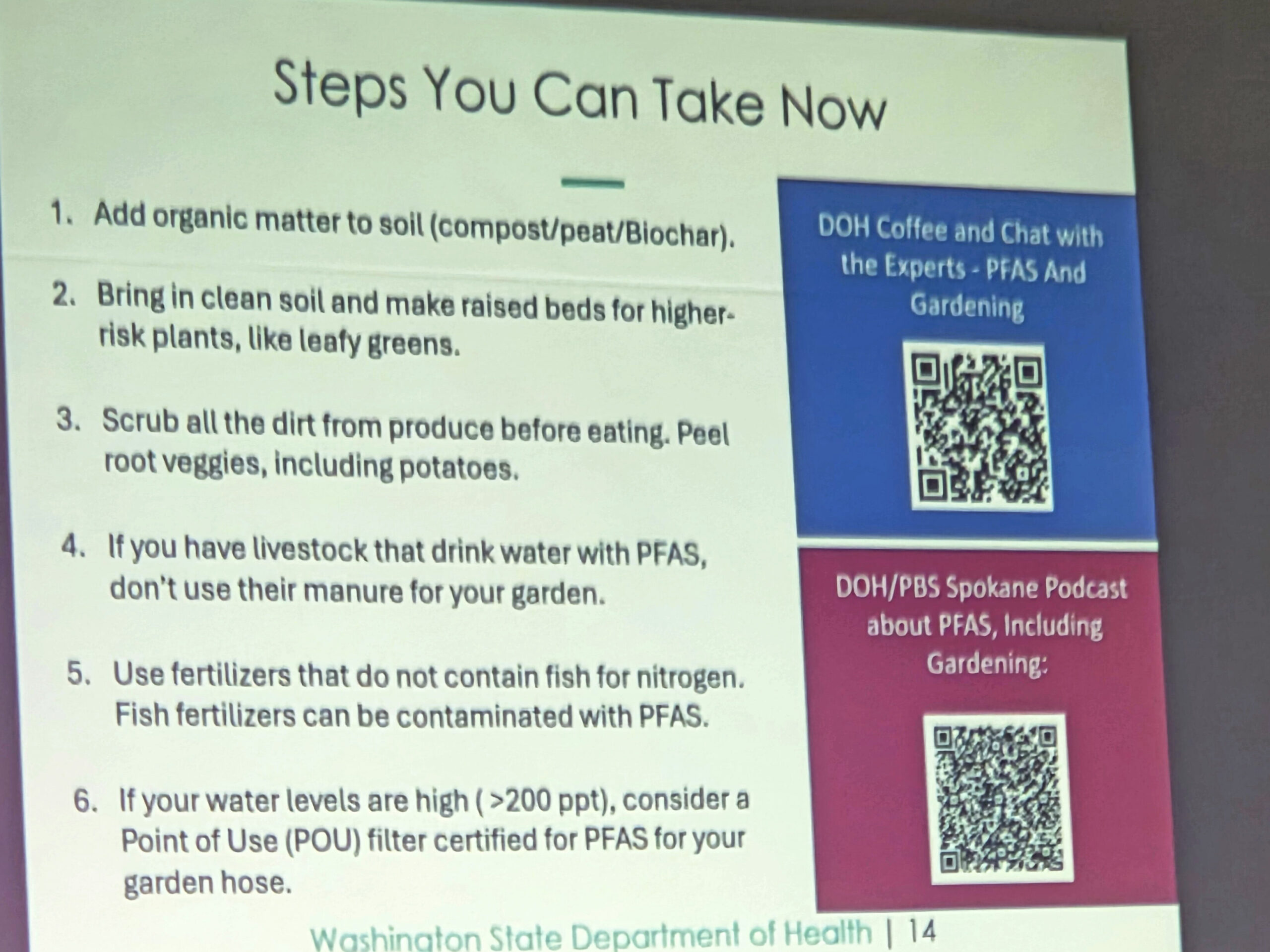
There are other things people can do to reduce contamination as well. People should avoid feed made with fish meal, since that could be an additional source of contamination. When eating farm-raised animals, people should avoid eating their organs and manure from contaminated animals should not be used in a garden, she said.
Sixteen households provided 28 samples of meat, including beef, chicken, pork and turkey. Most tested clean, with only 25 percent of households advised to either severely or moderately restrict their intake.
The good news is that if sources of contamination are removed, animals are able to clear the chemicals from their system relatively quickly, Morrissey said. “They actually excrete PFAS faster than people can,” she said.
Health Educator Claire Nitsche said there are a wide variety of variables that can affect the safety of fruit and produce, including the levels of contamination in the water and soil as well as the soil type. The type of contamination also plays a role, with long-chain chemicals like PFOS and PFOA lingering in plant roots and short-chain chemicals like PFBA settling in stems, leaves and fruits.
“It’s because of where the PFAS gets stuck,” Nitsche said. “We have only had science around PFAS and gardening for two years. We have enough information to know that PFAS can move into garden produce.”
Nitsche said she knows that people are worried about the safety of the food they grow and has had some people tell her they have stopped gardening completely. “This is a big issue,” she said. “It really impacts people’s sense of well being in their homes.”

Higher risk items to eat include leafy greens like spinach and lettuce, green beans, celery, rhubarb and roots like radishes, beets and carrots. Foods that are a lower risk include onion, garlic, potatoes, tree fruits and nuts, tomatoes, cucumbers, melons, peppers and corn. In the case of corn, contamination has been found in the leaves of contaminated plants, but not in the ear itself.
There are steps people can take to garden more safely, including using filtered water. Adding organic matter such as compost, peat and biochar helps because the PFAS binds to the organic matter. Bringing in clean soil to use in raised garden beds is also effective, though it’s not cheap. “This is very expensive and hard for people,” Nitsche said.
Produce should be scrubbed of all dirt before eating and root vegetables, such as potatoes, should be peeled.
It’s clear that the food we eat can be a source of PFAS contamination, not just the water, Morrissey said. “This is an important pathway of exposure that needs to be investigated further and mitigated,” she said.
Morrissey said she is hoping to get funding to do testing of garden produce this summer. West Plains residents interested in providing produce for testing can contact Morrissey at barbara.morrissey@doh.wa.gov.